
The SpinAligner Polarizer
Our product
The SpinAligner Polarizer
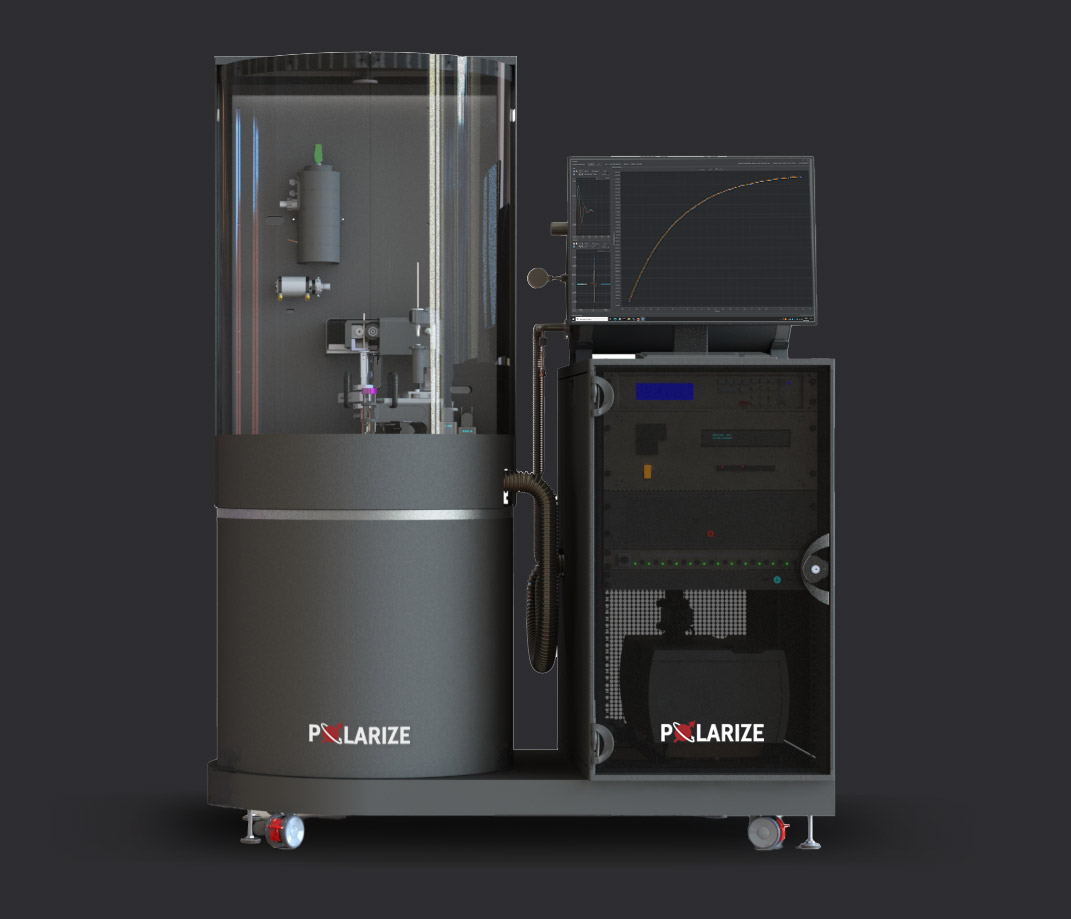
Specifications
- 56.7 T persistent, dry magnet with low drift rate and fixed leads (Cryogenic Ltd).
- 5Re-condensing, variable temperature insert with base temperature of below 1.4 K temperature controllable to 300 K continuously.
- 5No liquid cryogens needed. Cooling provided by Sumitomo SRP-082B cold head and F-70H compressor.
- 5Microwave frequency 188 ± 2.0 GHz / frequency modulation / pulse modulation / gating / 100 mW / 20 dB attenuation.
- 5NMR probe tuned for 13C (72 MHz). NMR coil tuned remotely to provide flexibility for other nuclei.
- 5Solid-state NMR spectrometer for measuring polarization build-up. Based on RS2D Cameleon 4, T/R switch, 300 W amplifier (5-310 MHz) and SPINit software.
- 5Fluid path optimized for dissolution of pre-clinical and in vitro samples.
- 5Fully automated software control.
- 5Polarizer foot print 1.42 x 0.80 m2, height 1.85 m. Minimum floor space required for operation and service 4 m2. Weight: SpinAligner 400 kg; compressor 100 kg
Acceptance test
- 52 mL of 80 mM [1-13C]pyruvate with liquid state polarization above 50% at time of dissolution.
Installation requirements
- 5Compressor requires cooling water and 3-phase electricity.
- 5SpinAligner requires 240 V / 10 A (50 Hz or 60 Hz)
- 5Helium gas 5.0 (50 L/200 bar cylinder or equivalent).
- 5Compressed air above 5 bar.
The SpinAligner offers high impact across many applications
01
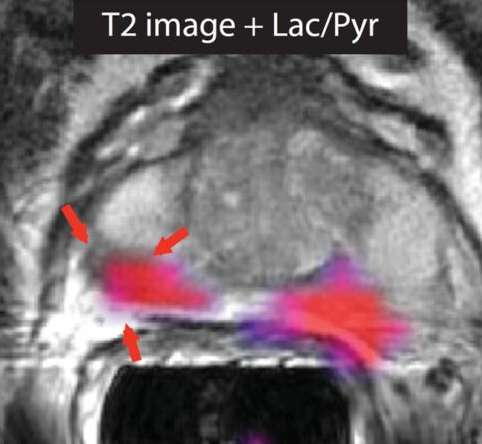
Clinical SpinAligner
We expect to launch a SpinAligner that is capable of supporting clinical research in early 2027. It will deliver a safe-to-inject clinical dose of 13C-pyruvate, and Polarize will provide the documentation required to apply national authorities for human use. The project is supported the European Union,Response. We are taking orders.
02
UV induced radicals
Non-persistent radicals can be generated with UV light from e.g. pyruvic acid, alpha-ketoglutaric acid, or alpha-ketoisocaproic acid. These radicals are stable at liquid nitrogen temperature and provide strong DNP. Moreover, these radicals are labile and quench into diamagnetic species at the moment of dissolution, with a positive effect on the relaxation time of the hyperpolarized molecule and no need for filtration of the radical. Polarize can offer a complete solution to produce “UV-DNP” samples and use them on the SpinAligner. The image shows hyperpolarized CSI in awake mice using UV-irradiated [d4, 1-13C]pyruvic acid (courtesy of Dr Yuhei Takado, QST, Shiba, Japan).

03
SpinAligner mini
At Polarize we are committed to innovation. Dissolution DNP is not only in vivo hyperpolarized metabolic imaging. Cells cultures are great systems to investigate metabolism and test drugs by means of Magnetic Resonance Spectroscopy. In this case high throughput is more important than high polarization. To this regard, we are developing a new product (i.e. the SpinAligner mini): a small footprint and portable polarizer based on permanent magnets that can enhance the 13C liquid-state NMR signal on a benchtop spectrometer by 5 orders of magnitude in tens of seconds.

04
Hyperpolarized 129Xe MRI
One of the strengths of DNP is that many NMR active nuclei can be hyperpolarized, even compounds that are in the gas state at room temperature. Hyperpolarized 129-Xenon gas is widely used for lung ventilation and perfusion imaging. The SpinAligner is also capable of hyperpolarizing 129-Xenon, and we succeeded in recording the first in vivo dDNP hyperpolarized 129Xe lung imaging in a pig (courtesy of Prof Christoffer Laustsen, MR Research Center, Aarhus, Denmark).

05
Polarimeter for liquid-state polarization measurement
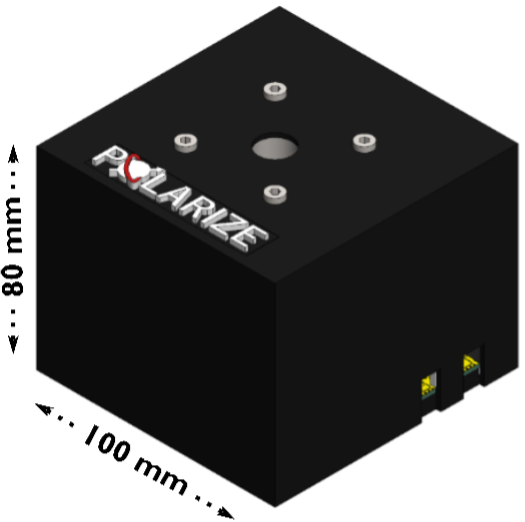
Measuring the liquid polarization right after dissolution can be useful quality assurance prior to any in vivo application. Polarize can offer a compact polarimeter based on a permanent magnet that allows online measurement of the liquid-state polarization of your compound right after dissolution, and without delaying or interfering with the main experiment.
06
Hyperpolarized water (1H)
Hyperpolarized water (1H) has already been demonstrated to obtain high contrast angiographic and perfusion images in animal models with no need for any paramagnetic metallic compound (e.g., Gd3+)13,14, or non-standard MRI equipment and sequences as for HP 13C experiments15. Moreover, fast exchange with HP water 1H nuclei has been used to enhance the sensitivity and reduce the scanning time in 1D and 2D MRS experiments on biomolecules dynamics, protein structure determination and protein–ligands interaction.

07
15N-betaine, a long-lived tracer
Hyperpolarized [15N,d9]-betaine is a metabolite with a long T1. With in vivo detectability exceeding 14 min and high polarization, [15N,d9]-betaine supports real-time and late-phase imaging from a single injection, enabling flexible, multistage imaging. This extended imaging window facilitates tracking molecular distribution, assessing tissue perfusion, and monitoring cellular uptake relevant to betaine’s roles in cellular protection.
- Skre et al., Sci.Adv. 11 (2025). DOI:10.1126/sciadv.adx8417.
- Ashikaga et al. ChemRxiv (2025); DOI:10.26434/chemrxiv-2025-0qxks

08
13C-KIC, branched-chain amino acid metabolism
[1-13C]-2-ketoisocaproate (KIC) enables imaging of branched-chain amino acid (BCAA) metabolism. KIC is converted to the essential amino acid [1-13C]leucine via the branched-chain amino acid transaminase (BCAT), a reaction that has been imaged in vivo in rodents in both healthy tissue and in cancer models. KIC also exhibits favourable polarization characteristics and scalable dosing, supporting its potential for clinical translation. The ability to image BCAA metabolism is particularly relevant, since its dysregulation has been implicated in cancer and neurodegenerative disease.
